My twice-monthly newsletter helps parents in multicultural relationships explore how their own cultural upbringing shapes their parenting instincts, so that they can bring more curiosity and self-awareness into their relationship and the way they raise their child. Surface Tension weaves together personal story, cultural reflection, and expert guidance to help parents better understand themselves, and make space for the differences that give their family its depth and warmth.
Children in the Circle, and How Belonging Feels
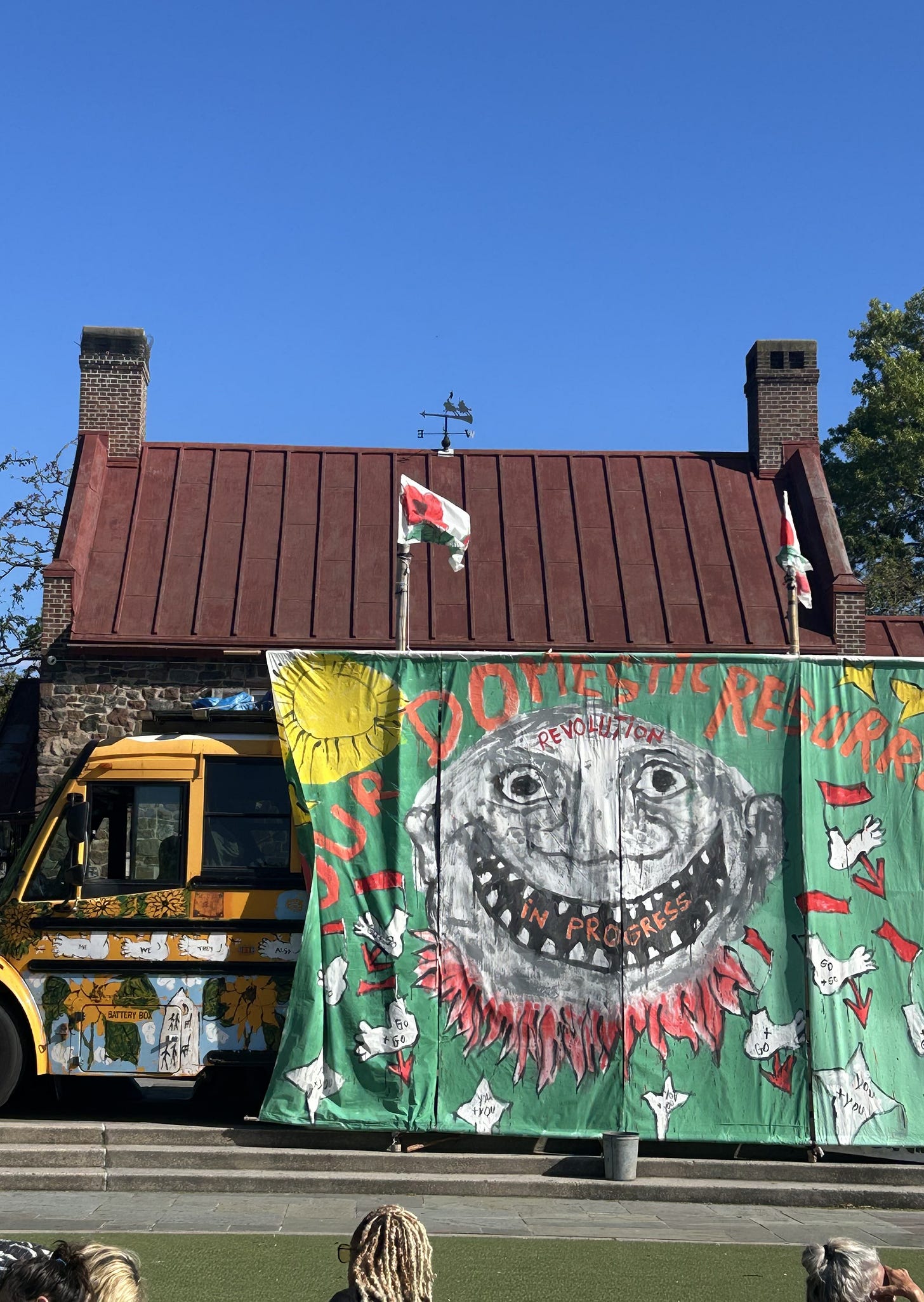
Children in the Circle, and How Belonging FeelsThe invisible scripts that shape how children join community life. In my own life, I’ve also been noticing the different ways children enter community life across cultural settings.Not just whether they’re there, but how they’re there. What role they’re invited to play. What part of themselves they get to bring forward. And how the adults present include them (or don’t.) That question stayed with me over the last couple of weeks as I took my own kids into different spaces. Bread and Puppet Theater: Shared Story, Shared SongOne Friday after school, we rushed across Brooklyn to see Bread and Puppet Theater with my parents. They had last seen the company in Paris in the 1980s. We joined families gathered on a lawn, facing a school bus turned set piece with a hand-painted backdrop reading Our Domestic Resurrection Revolution in Progress. A group of local musicians who had joined the company for the performance struck up a familiar but unexpected Chilean protest song. My five-year-old, sitting closer to the stage, turned to find us with a giant smile of recognition and yelled to get our attention. My daughters, like me, have grown up chanting el pueblo unido jamás será vencido at marches and, on occasion, at bedtime. I caught myself dreading needing to shush her, or to rush over and sit her securely in my lap. I quickly scanned the crowd, trying to read the room. Were people annoyed?At other shows I’ve taken my kids to, from the Metropolitan opera to story time at the library, the expectation is to sit still, stay quiet, and listen. Those scripts about “appropriate behavior” kicked in before I even realized it. But at Bread and Puppet, I slowly realized the opposite was true. Next to me, my parents had leapt to their feet, fists raised, to sing loudly alongside the company. I felt my heart expand with gratitude at being able to share this moment together. It was comforting to notice that none of us needed to perform “good assembly etiquette” (as the teachers at my kids’ school call it, and which includes “clapping only when appropriate”) to belong.
Bread and Puppet has always been about more than entertainment. Their radical circuses are about pulling the community into a shared ritual where everyone—from the puppeteers, to the musicians, to the audience (including children)—contributes. Jeering, cheering, and chanting is encouraged. None of it is dumbed down for kids. My daughters were wiggly, curious, full of questions, and still welcomed as they were.Watching them, I remembered how they were folded into another intergenerational circle a few years ago. On my uncle’s porch in Puerto Rico during Día de Reyes, my family sang décimas, improvised ten-line verses carrying humor, history, and family lore. The songs are living archives built over the years. My adult cousins added lyrics, others joined with a guitar or güiro. Children were invited too, handed instruments or danced with. But their role was different. They listened, clapped, and danced along, taking in the rhythm and the stories until the day they’d be old enough to add their own verses. Both Bread and Puppet and my Puerto Rican family wove children into culture-making, not by centering them, but by trusting them to find their place inside a larger, intergenerational story. Sure, much of it went over their heads, but a lot of it landed, too. As my eight-year-old affirmed, eyes wide open, during the puppet show: “Everything they are saying up there is true.” Belonging isn’t just personalThe urge to shush my children that rose up in me at Bread and Puppet wasn’t really about my kids. It was about me navigating the invisible rules of the space.In some spaces, children are expected to be quiet; in others, they are expected to participate. I was wrestling with what role was appropriate for them to play and how my parenting would be read by the other adults in the circle. I notice the same thing at playgrounds or playdates. Every time we walk up to a new group of kids, I find myself scanning the scene to figure out the invisible rules.How do these kids share? What’s considered too rough? Who gets included and who gets left out? And what is my role as an adult? My kids, too, pick up on those cues, though not all children do. Sometimes they fit right in. Sometimes the rules feel confusing, or even stacked against them. In those moments, I feel that same tension rising in me: Do I intervene? Do I hold back? Am I teaching them to adapt or protecting them from exclusion? What shapes these norms?Ideas about “good behavior” are deeply cultural.
None of these dynamics are neutral. They carry histories of how we think about authority, knowledge, and belonging. They also carry real consequences. For some kids, the “rules” of a space feel intuitive or welcoming, for others they’re a mismatch. Those mismatches often reflect bigger forces: whose cultural norms are being privileged, whose voices are amplified, and whose ways of being are treated as disruptive. For parents navigating more than one cultural world (as most of us are), this can be disorienting. Whose rules do we follow? What feels familiar? What feels strange or even harmful? And what happens when my instincts and others’ don’t align?Notice Together, Connect TogetherOften, the way we notice belonging comes from the stories we carry from our own childhoods. The way Bread and Puppet included children felt familiar to me, but it might have felt chaotic to someone else for whom enforcing “good assembly etiquette” comes more naturally. Sharing our reflections about these questions with others can create space for curiosity, especially when our instincts about how children should behave don’t always align. Here are two questions to get the conversation started with your partner this week: What’s one intergenerational gathering or tradition from your childhood that made you feel like you belonged?And what do you hope our kids will remember in the same way?Until next time, Melina |
Surface Tension
My twice-monthly newsletter helps parents in multicultural relationships explore how their own cultural upbringing shapes their parenting instincts, so that they can bring more curiosity and self-awareness into their relationship and the way they raise their child. Surface Tension weaves together personal story, cultural reflection, and expert guidance to help parents better understand themselves, and make space for the differences that give their family its depth and warmth.
It looks like a simple question: “Can you help me?” Usually accompanied by those big eyes that are hard to resist. The moment your child asks you, your instinct kicks in (or maybe you feel it as tension): do you step in, or hold back? And what about your partner—would they handle it the same way, or differently? Underneath it all is a deeper question: What does it mean to care? Every parenting moment carries culture. Even the tiny ones. Sometimes it feels like you and your partner are...
Before we begin... For those of you who have been on my email list for a while, thank you! When I first began writing, I was often doing it while holding a sleeping baby or toddler. These days, my children are older and I have found the space to devote to writing you more regularly (and at regular hours!) You'll now hear from me twice a month. The Nightlight, the newsletter I've been sending you sporadically for years, is now Surface Tension. I'll still be writing about culture and parenting,...